
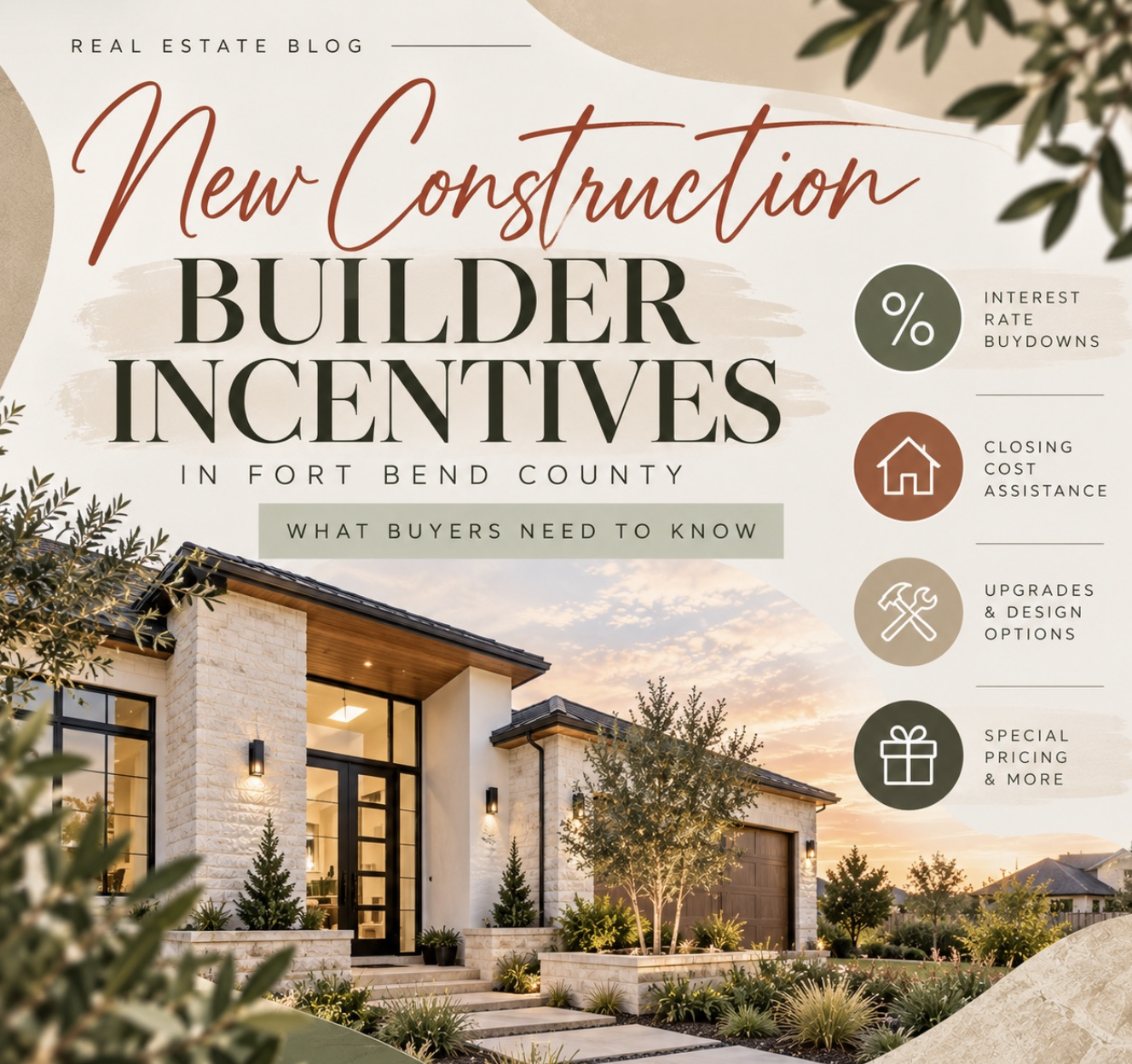
If you’re shopping for a new construction home in Fort Bend County, you may see builders advertising incentives such as mortgage rate buydowns, closing cost assistance, design center credits, upgrade packages, or special pricing on select inventory homes. These offers can potentially save buyers thousands of dollars—but the biggest advertised incentive isn’t automatically the best financial deal.
Whether you’re considering a new home in Sugar Land, Missouri City, Richmond, Rosenberg, or the West Houston area, understanding how builder incentives work can help you compare homes and financing options more effectively.
What Are Builder Incentives?
Builder incentives are financial or non-financial benefits offered by a homebuilder to encourage a buyer to purchase a new construction home.
Common incentives can include:
- Contributions toward closing costs
- Temporary or permanent mortgage rate buydowns
- Discount points paid toward the buyer’s mortgage
- Price reductions on selected inventory homes
- Design-center or upgrade allowances
- Appliance packages
- Assistance with certain title or financing expenses
- Incentives tied to using the builder’s preferred lender or title company
The exact offer can vary not only from builder to builder but also from community to community and even house to house. A builder may offer one incentive on a home that is still under construction and a different package on a completed inventory home that is ready for move-in.
Why Do Builders Offer Incentives?
Builders use incentives for many of the same reasons other sellers negotiate: to make a particular property or transaction more attractive. For example, a builder may want to sell completed inventory, reach a sales objective, move homes in a particular phase of a community, or encourage buyers to close within a certain period.
Instead of reducing the advertised price, a builder might offer money toward financing or closing costs. For buyers, that distinction matters. A lower purchase price, lower interest rate, closing cost credit, and upgrade allowance can each affect your finances differently. The right way to evaluate an offer is to look at the total transaction, not simply the advertised dollar amount.
1. Mortgage Rate Buydowns Can Be Valuable, But Understand the Details
Mortgage incentives are among the most attention grabbing builder promotions. A builder may contribute money that helps reduce a buyer’s mortgage rate through discount points or another financing structure. There are two broad types buyers may encounter.
Permanent Rate Buydown:
Money is used to obtain a lower interest rate for the mortgage under the lender’s terms. The potential benefit continues beyond the first few years of the loan as long as that mortgage remains in place.
Temporary Rate Buydown:
The effective payment is reduced for an initial period before increasing according to the terms of the loan and buydown arrangement. For example, buyers may hear terms such as a 2-1 buydown, although available programs and qualification requirements vary.
When evaluating either option, ask:
What is the actual note rate? How long does the payment reduction last? What will the payment become afterward? What happens to the benefit if I refinance or sell the home?
Don’t compare mortgages based only on an advertised rate. The Consumer Financial Protection Bureau recommends comparing Loan Estimates from multiple lenders and looking at factors including the interest rate, monthly principal and interest payment, points or credits, cash needed at closing, and overall loan costs.
2. Closing Cost Assistance Can Reduce the Cash You Need Up Front:
Another common new construction incentive is a contribution toward allowable buyer closing costs. Depending on the transaction and loan program, these funds may help with eligible expenses associated with obtaining the mortgage and completing the purchase.
This can be particularly useful for a buyer who would rather preserve cash for moving expenses, furnishings, emergency savings, or other post-closing needs. There is an important limitation, however: builder and seller contributions are subject to mortgage program rules.
For example, conventional mortgage guidelines can limit financing concessions according to factors such as occupancy and loan to value ratio. Freddie Mac’s current guidance specifically identifies builders and developers as interested parties and establishes limits on financing concessions.
That means an advertised credit isn’t necessarily money a buyer can use however they want. Before assuming you’ll receive the full benefit, have your lender explain exactly how much of the incentive can be applied to your particular loan.
3. Preferred Lender Incentives Deserve a Side by Side Comparison:
Some of the most attractive new-home incentives are conditional on financing through a builder’s affiliated or preferred lender. That does not automatically make the preferred lender a good or bad choice. It simply means buyers should compare the complete numbers.
The Consumer Financial Protection Bureau notes that buyers of new construction may encounter a mortgage lender associated with the builder, but buyers can still shop around for financing. Ask an outside lender to quote the same loan type, loan amount, down payment, lock period, and comparable points or credits whenever possible.
Then compare:
- Interest rate
- APR
- Discount points
- Lender fees
- Builder or lender credits
- Monthly principal and interest
- Mortgage insurance, when applicable
- Estimated cash to close
- Length and terms of any rate lock
- Total borrowing cost over the period you realistically expect to own the home
A $15,000 incentive from one financing package, for example, shouldn’t automatically be treated as $15,000 of savings compared with another lender. The rates, fees, points, and other terms may be different. The goal is an apples to apples comparison.
4. Ask Whether an Incentive Can Be Exchanged for Something Else:
Builder promotions aren’t always one size fits all. Depending on the home, community, builder, financing program, and current promotion, there may be choices in how an available incentive is structured.
A buyer might place greater value on reducing cash needed at closing, while another might prefer a financing incentive. Someone purchasing a completed inventory home might prioritize price, while a buyer selecting a home earlier in construction may care more about upgrades. Ask questions before assuming the advertised package is the only available structure.
Possible questions include:
Is there an alternative incentive if I don’t use the preferred lender?
Does the incentive apply to every home or only selected inventory?
Can any portion be applied toward allowable closing costs or financing expenses?
Are upgrades already included in the home’s price?
Does the incentive require closing by a particular date?
The answers can materially change the economics of the purchase.
5. Inventory Homes May Have Different Incentives:
If maximizing available incentives is important to you, pay particular attention to quick move-in, spec, and completed inventory homes. These homes can have different promotions from homes that haven’t yet been built.
Why?
A completed home represents capital the builder has already invested in land, materials, labor, financing, and carrying costs. Depending on market conditions and the builder’s objectives, there may be motivation to sell particular inventory.
That doesn’t mean every completed home will be heavily discounted. It means buyers should compare the incentives attached to specific properties, rather than assuming every house in a community carries the same promotion.
6. Don’t Overlook Property Taxes, HOA Costs, Insurance, and Special Districts:
An attractive mortgage incentive can make a new home’s initial payment look appealing, but buyers should evaluate the complete cost of ownership.
This is particularly important when comparing new communities throughout Richmond, Rosenberg, Missouri City, Sugar Land, Fort Bend County, and the greater West Houston area.
Depending on the property, ongoing housing expenses can include:
- Property taxes
- Homeowners insurance
- HOA assessments
- Flood insurance when applicable or desired
- Municipal Utility District or other applicable taxes and assessments
- Maintenance
- Utilities
Ask your lender for a realistic estimate of the total monthly housing payment, rather than focusing only on principal and interest. Also verify property tax information for the specific property instead of assuming that two similarly priced homes will have identical tax obligations.
7. Understand the Difference Between Base Price and Final Price:
A builder’s advertised starting price isn’t necessarily the amount a buyer will ultimately pay.
Depending on the home and stage of construction, the final price may include items such as:
- Lot premiums
- Structural options
- Design selections
- Upgraded flooring
- Cabinets and countertops
- Electrical additions
- Outdoor living features
- Other builder options
Freddie Mac’s appraisal guidance for new construction says the sales contract should state the home’s base price and itemize options. This makes it especially important to compare final specifications and final prices, not merely community starting prices. A home advertised from the $400,000s, for example, could have a materially different final price once the homesite and selected features are included.
8. Builder Contracts Are Different From Typical Resale Contracts:
Buying new construction isn’t identical to buying a resale home. Builders commonly use their own contracts, which may contain provisions concerning deposits, construction timelines, financing deadlines, inspections, change orders, delays, incentives, and closing requirements.
Before signing, understand:
- How much deposit is required
- Whether and when the deposit is refundable
- Financing deadlines
- What happens if the home doesn’t appraise at the contract price
- Inspection provisions
- Construction and closing timelines
- Which incentives are written into the agreement
- What could cause an incentive to change or disappear
The CFPB specifically advises buyers considering a home that hasn’t yet been built to ask the builder under what circumstances the builder deposit can be returned. Verbal promises should not be assumed to replace written contract terms.
9. Consider Independent Inspections on New Construction:
A newly built home is new, but that doesn’t mean buyers should automatically assume an independent inspection has no value. Depending on the construction stage and the terms of the builder contract, buyers may consider inspections at different points in the process, such as before drywall or before closing.
Inspection rights, timing, access, and procedures can vary by builder and contract, so determine what is permitted before signing. A builder warranty and an independent inspection serve different purposes. Buyers should understand both.
10. Investors Should Verify Incentive and Financing Rules Separately:
Fort Bend County also attracts buyers considering new construction as an investment. Investors should not assume that an incentive advertised to an owner-occupant will apply to an investment-property purchase.
Loan guidelines can treat investor transactions differently. For example, Freddie Mac’s current conventional guidelines generally limit financing concessions on investment properties to 2% of value, while different limits can apply to qualifying primary residences and second homes depending on loan-to-value. Builders may also have their own restrictions regarding investors, leasing, the number of investor-owned homes within a community, or when a property can be rented.
Verify the rules for the specific property, builder, community, and financing program before committing funds.
Builder Incentives in Sugar Land and Missouri City:
Buyers searching for new construction in Sugar Land and Missouri City should compare more than the advertised home price. Location within the community, tax rates, HOA obligations, school zoning, commute considerations, included features, and financing incentives can all affect the overall value proposition.
A promotion that reduces upfront costs may be attractive, but it should be evaluated alongside the property’s long-term carrying costs and your personal ownership plans.
Builder Incentives in Richmond and Rosenberg:
Richmond and Rosenberg: include substantial new home development, giving buyers opportunities to compare builders, communities, floor plans, and inventory homes.
When touring model homes, ask for an incentive sheet covering the specific property you’re considering. Don’t assume the promotion advertised online applies to every floor plan or homesite. Ask when the promotion expires, whether it requires a preferred lender, and what happens if the closing date changes.
Comparing Fort Bend County With West Houston:
Some buyers searching Fort Bend County also consider West Houston and surrounding communities. Instead of comparing properties solely by purchase price, calculate the broader cost of ownership. Compare taxes, HOA expenses, insurance, commute, financing, included upgrades, cash required at closing, and the final monthly payment. This produces a much more useful comparison than asking which community has the biggest advertised builder incentive.
How to Evaluate a Builder Incentive Before You Sign:
Before signing a new construction contract, request the numbers in writing and compare the transaction with and without the incentive whenever possible.
A useful buyer checklist is:
- Get the complete price of the home, including lot premiums and options.
- Request an itemized explanation of every builder incentive.
- Determine whether the offer requires a preferred lender or title company.
- Obtain Loan Estimates so financing offers can be compared.
- Calculate your estimated cash to close.
- Calculate the projected total monthly housing payment.
- Ask whether a mortgage buydown is temporary or permanent.
- Review property taxes, HOA costs, insurance, and applicable district assessments.
- Understand deposits, deadlines, inspection provisions, and financing requirements before signing.
- Make sure negotiated incentives and important terms are documented in the contract or appropriate transaction documents.
The Bottom Line for Fort Bend County Homebuyers
Builder incentives can make purchasing a new construction home more attractive, especially when they reduce financing costs or the amount of cash required at closing. But an incentive should be evaluated as one part of the entire purchase.
For buyers considering Sugar Land, Missouri City, Richmond, Rosenberg, Fort Bend County, or West Houston, the most useful comparison includes the home’s final price, financing terms, incentives, taxes, insurance, HOA expenses, included features, and long-term monthly cost.
The headline incentive gets attention.
The complete numbers tell you what the home will actually cost.
If you’re considering new construction in Fort Bend County or West Houston, having representation that understands builder contracts, incentives, inventory homes, and local communities can help you ask the right questions before signing.
Builder promotions, mortgage rates, lending guidelines, tax rates, and available incentives can change. Buyers should verify current terms with the builder, lender, applicable taxing authorities, and appropriate professionals before making financial or contractual decisions.
Q: Are builder incentives negotiable?
A: Sometimes. Incentives vary by builder, community, home, financing, and timing. Buyers can ask about closing costs, rate incentives, upgrades, or price adjustments.
Q: Is a rate buydown or price reduction better?
A: It depends. A rate buydown can lower monthly payments, while a price reduction lowers the purchase price. Compare payments, cash to close, loan costs, and how long you plan to own the home.
Q: Do I have to use the builder’s preferred lender?
A: Not necessarily. Some incentives may require the builder’s preferred lender, but buyers can still shop around and compare financing options.